Research
Master Thesis
A research thesis examining why generative design has not been widely adopted in architecture — identifying computational literacy as the key barrier and proposing practical paths forward.
- Year
- 2020
- Role
- Student
- Tools
- Rhino · Grasshopper
About this project
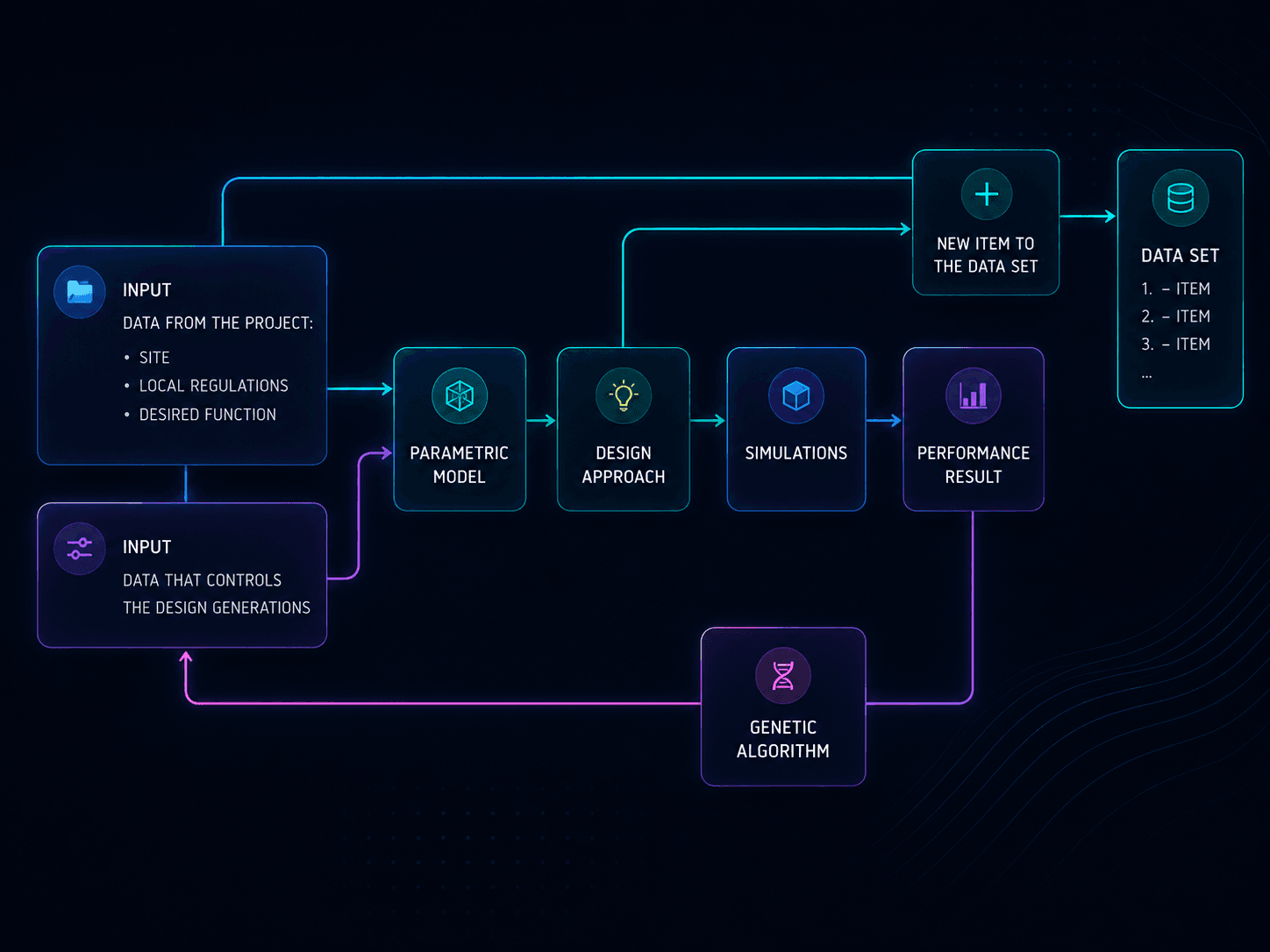
The purpose of this study is to examine the generative design methodology and determine the reasons for its limited uptake in practice. Despite its potential, the methodology has yet to be widely adopted in architecture. The thesis begins with an overview of generative design — its fundamental principles and operations — then analyses three key components in depth: parametric modelling, which generates multiple design solutions; building performance analysis, which evaluates those solutions; and optimization, which selects the best. Several case studies were examined throughout.
The research concludes that generative design has no essential technical weaknesses blocking adoption. The real barrier is a lack of computational literacy among practising architects: the methodology requires the ability to build parametric models that generate multiple design alternatives, which demands a level of expertise that most practitioners currently lack.
The thesis proposes three responses: dedicated computational specialists integrated into project teams, improved computational design education, and software purpose-built to lower the barrier to parametric modelling.